
By Mah-Noor Ghani – Research Volunteer
Last year I travelled to Pakistan to conduct fieldwork for my Master’s dissertation in Sociology of Childhood and Children’s Rights. As an educator, fostering panel member and workshop facilitator involved in various child-focused projects, I’ve long been committed to amplifying children’s voices, rights and lived experiences. During my studies, I had the exciting opportunity to volunteer with ‘Cities for Children’ as a Development Intern, working with both their UK and Pakistan teams. My role involved developing resources, supporting in the development of safeguarding training and in the delivery of their ‘Sikho Sikhao Saathi’ (Partners in Learning) project with refugee students in London schools.
Our UK based team often received updates from colleagues in Pakistan about how the project was progressing across schools and Basic Education Community Schools (BECS) in Rawalpindi. What fascinated me most was the child-to-child model the project was based on: a peer-led approach where out-of-school children aged 11 to 13 were trained as Big Partners to deliver engaging and interactive educational sessions to younger Little Partners. This approach not only supported foundational learning and social-emotional development for marginalised children, but also empowered the Big Partners, helping them grow in confidence, leadership and agency. The idea of children as both learners and changemakers resonated deeply with my values and the focus of my studies.
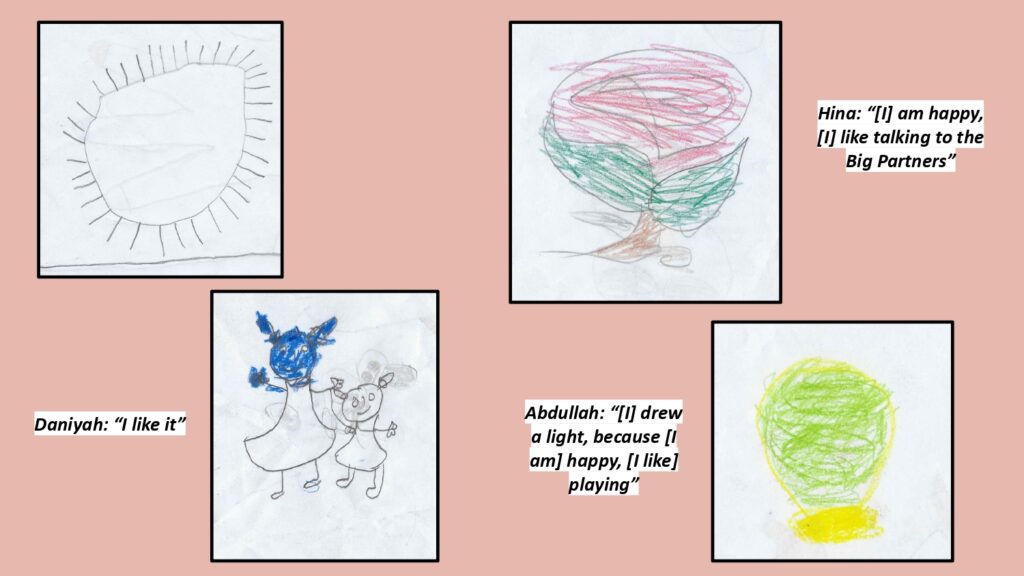
My fieldwork focused on the Sikho Sikhao Saathi (Partners in Learning) project, designed by Cities for Children and delivered through community learning centres and a school run by ‘Junior Jinnah Trust’ – a non-profit organisation focused on making quality education accessible for marginalised and unprivileged children in Pakistan. Over the course of a month, I observed sessions, held interviews and group discussions with the children and teaching staff, and facilitated a creative Draw and Tell activity with the Big and Little Partners. I wanted to explore how the children experienced their roles and how this shaped their relationships, sense of agency, views on education and imagined futures.
One of the most striking findings was the strength of the relationships between Big and Little Partners. The older children didn’t just teach lessons, they played with their Little Partners, helped feed them at lunchtime and taught them good manners and kindness. Teachers spoke about how Little Partners had initially come to school crying, unwilling to stay, but within weeks they were arriving happily, excited to learn and play with their Big Partners.
Teacher: “At the start of the programme, [the Little Partners] would not talk to [the Big Partners], they would not even share their names, they would be crying, we would be bringing them as in whilst they would be crying, now thank God, they come happily themselves, even when we see them on our way to school, they themselves say “hello ma’am, asalaamualaikum”, “are we coming on Friday?””
A sense of care and responsibility was a constant theme. One Big Partner said she saw her Little Partners as “choti behnein” (little sisters) – a reflection of the empathy and responsibility that came with the role. These bonds gave the younger children a sense of belonging and support, and gave the older ones a sense of purpose and responsibility.
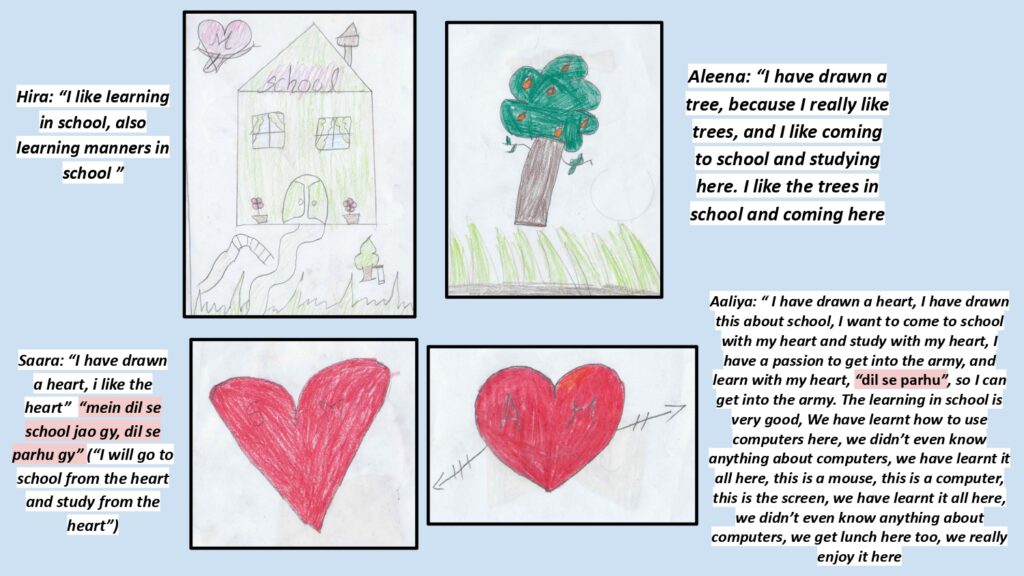
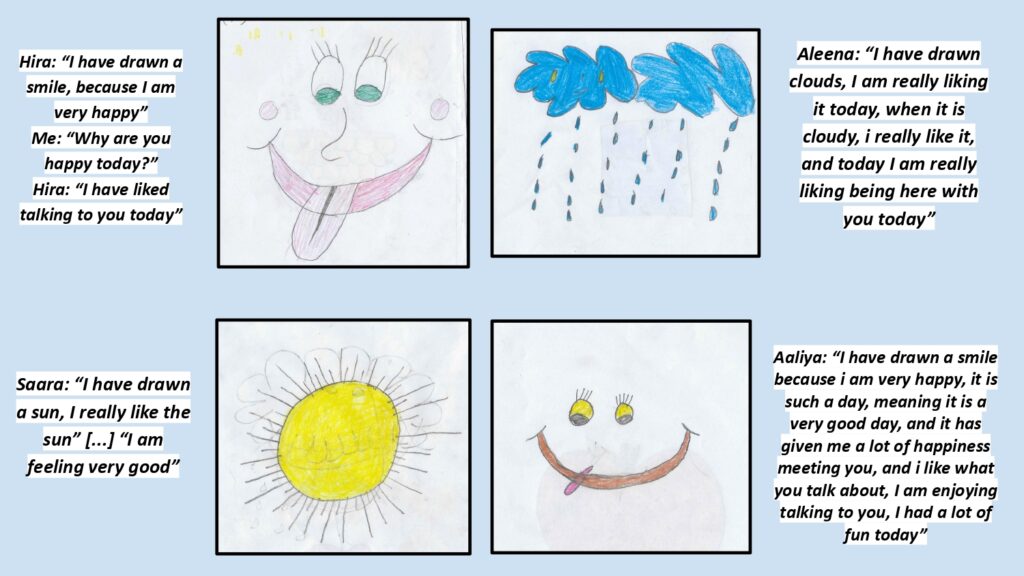
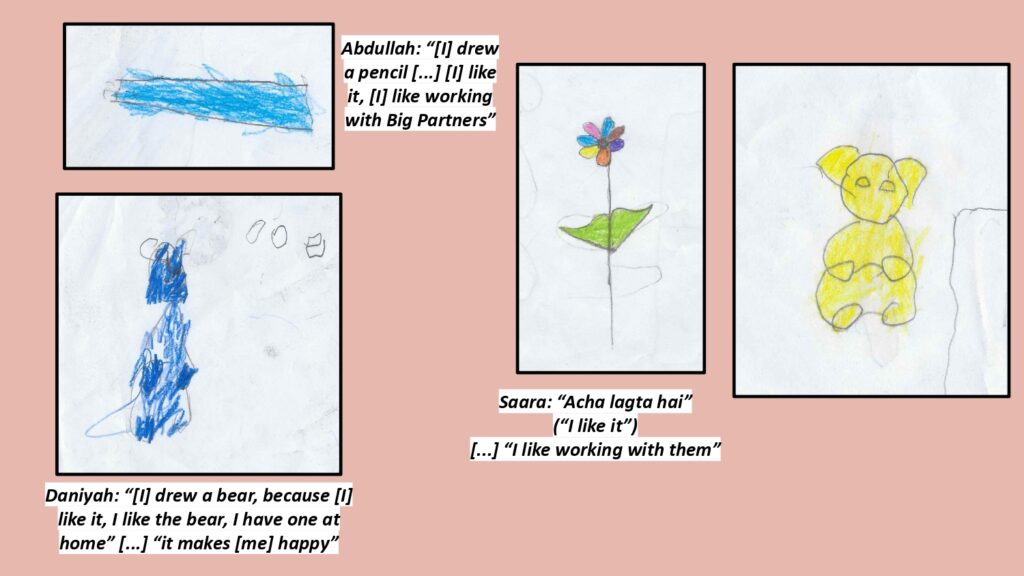
Despite facing challenges such as poverty, social expectations and family pressures, the Big Partners consistently expressed joy in coming to school and pride in what they were doing. Some had family members who didn’t initially support their education, yet they remained determined to attend. During the Draw and Tell activity, many drew pictures filled with books, hearts, trees and clouds – symbols of happiness, hope and care. Some of them included rain and clouds, which they expressed a liking for and linked these to the idea of school as a place they enjoyed coming to.
Big Partner: “I like clouds a lot, and I really like it being a Big Partner”
Their experience as leaders also influenced how they imagined their futures. Many said they wanted to become teachers, inspired by their work with the younger children.
Big Partner: “I also hope to continue teaching the children, that they learn something and we learn something, and so that we may grow up and become teachers”
None of this growth would have been possible without the patient support of their teachers, who modelled compassion and guided them through challenges.
Big Partner: “Our teachers are like our parents, so this is why before making any decision we would ask teachers”
My time in Rawalpindi confirmed what I had hoped to explore: that peer-led education, when nurtured with trust and support, can be transformative. It helps children not only to learn, but to lead, to build relationships, imagine new futures and see their own potential in a new light.
The Sikho Sikhao Saathi project is a reminder that when we trust children with responsibility and nurture their growth, they rise to meet and often exceed our expectations. It reveals the power of child leadership and the fruits of cultivating strong peer relationships amongst vulnerable children. The development of foundational learning and socio-emotional skills goes hand in hand, and as seen through this project, produces transformative results for all children involved.